Table of Contents
General on EU Legislation
This chapter provides an orientation to the EU legal system for readers who are not legal professionals. Understanding the basics presented here is essential for navigating any of the other chapters in this wiki, because the type of legal act determines whether a rule applies automatically and uniformly across all EU member states, or whether it must first be transposed into national law — which may result in variation between countries.
The algae sector does not have a single dedicated EU legal framework. It is instead governed by a patchwork of legislation from many different policy domains — food, feed, environment, water, energy, agriculture, fisheries and others — each with its own institutional origin, enforcement mechanism and amendment history. Knowing how to read, locate and interpret these acts is the starting point for any compliance assessment.
Sources of EU Law
EU law draws on three main sources:
- Primary law: the founding Treaties of the European Union (principally the Treaty on the Functioning of the European Union, TFEU, and the Treaty on European Union, TEU). These define the powers of EU institutions and the legal basis for all secondary legislation. They are not directly actionable in the day-to-day regulatory sense but define the outer boundary of what the EU may legislate on.
- Secondary law: Regulations, Directives, Decisions, Recommendations and Opinions adopted by EU institutions on the basis of the Treaties. This is the body of law that directly governs most practical activities, including algae production and use.
- Supplementary law: case law of the Court of Justice of the EU (CJEU), international agreements to which the EU is a party, and general principles of EU law. CJEU rulings are legally binding and can determine how secondary legislation is interpreted.
Types of Legal Acts
Regulation
A Regulation is a legal act of general application that is binding in its entirety and directly applicable in all EU member states immediately upon entry into force. It does not require national transposition: once published in the Official Journal of the EU, it becomes law in every member state simultaneously and uniformly. Most of the food, feed, novel food and cosmetics rules applicable to algae are Regulations. This means that when a Regulation sets a maximum contaminant level or requires an authorisation, the same rule applies in Slovenia, Germany and France without any further national legislative act being needed.
Directive
A Directive is binding as to the result to be achieved but leaves the choice of method and form to each member state. Member states must transpose a Directive into national law within a specified deadline, by adopting national legislation that achieves the required outcome. The practical implication for the algae sector is that Directives — such as the Water Framework Directive or the Habitats Directive — are not applied directly: their effect is felt through the national laws that transpose them, which may differ in detail from country to country. When reading a Directive, it is always necessary to check how each relevant member state has implemented it.
Decision
A Decision is a binding legal act that may have either general application or a specific addressee (a member state, a company, or an individual). Decisions cannot be applied incompletely, selectively or partially. In the algae context, Commission Decisions often appear as individual authorisation acts — for example, authorising a specific novel food under the novel food catalogue, or granting or refusing an application.
Recommendation
A Recommendation is a non-binding act. It allows EU institutions to set out a preferred approach or guidance without creating enforceable legal obligations. However, Recommendations are not without consequence: they may indicate the Commission's expected interpretation of binding rules, and national authorities and courts may take them into account. An important example for the algae sector is Commission Recommendation (EU) 2018/464 of 19 March 2018 on the monitoring of metals and iodine in seaweed, halophytes and products based on seaweed — this does not impose mandatory limits, but signals expected practice.
Opinion
An Opinion is also non-binding and is used by EU institutions to express a view on draft legislation or other matters without the force of law. The scientific opinions of the European Food Safety Authority (EFSA) are a special and particularly important category: while not legally binding in themselves, they form the scientific basis on which the Commission makes authorisation and risk management decisions. In practice, an adverse EFSA opinion is almost always fatal to a novel food or health claim application.
Implementing and Delegated Acts
Many EU Regulations delegate power to the European Commission to adopt further detailed rules without going through the full legislative procedure. Two instruments are used:
- Delegated Acts (adopted under Article 290 TFEU): used to supplement or amend non-essential elements of a Regulation. They are subject to scrutiny by the European Parliament and Council, which may object within a set period. Example: the Commission may adopt a Delegated Regulation to add a new species to the novel food authorisation list.
- Implementing Acts (adopted under Article 291 TFEU): used where uniform conditions for implementation are needed across member states. They are adopted following a comitology procedure involving a committee of member state representatives. Example: Commission Implementing Regulations specifying the format for novel food applications or setting out analytical methods.
In practical terms, this means that the main Regulation you read may not contain all the detail: important provisions — such as lists of authorised substances, maximum levels, or application formats — may be found in associated Implementing or Delegated Regulations that amend or supplement the parent act. EUR-Lex consolidated versions are the safest way to see the current state of a Regulation including all such amendments.
Standards and Certification
Alongside binding legislation, the EU makes use of harmonised standards developed by the European Committee for Standardisation (CEN) at the Commission's request. Standards are technically voluntary, but in some cases they are referenced in legislation as the preferred means of demonstrating compliance, giving them de facto mandatory status within their domain.
For algae specifically, CEN Technical Committee CEN/TC 454 “Algae and algae products” has developed a series of standards covering terminology, identification, processing, and specifications for food, feed, cosmetic and pharmaceutical applications. Key published outputs include:
- EN 17399:2024 — Algae and algae products: Vocabulary
- CEN/TR 17559:2022 — Algae and algae products: Food and feed applications — General overview of limits, procedures and analytical methods
- CEN/TR 17611:2021 — Algae and algae products: Specifications for cosmetic sector applications
- CEN/TR 17612:2021 — Algae and algae products: Specifications for pharmaceutical sector applications
These standards do not create legal obligations by themselves, but they represent the current best practice and are increasingly referenced by producers, buyers and regulators as a baseline for quality and safety assurance.
In addition, international standards — particularly ISO 22000 on food safety management systems and the related ISO/TS 22002 series — are widely used by algae producers and may be required by buyers or referenced in official controls.
The Role of EFSA
The European Food Safety Authority (EFSA), established by Regulation (EC) No 178/2002 (the General Food Law), is the independent body responsible for scientific risk assessment in the EU food chain. EFSA does not take regulatory decisions — it provides the scientific foundation on which the European Commission and member states base their decisions. Its role is specifically relevant to the algae sector in the following areas:
- Safety assessments of novel food applications (including new algal species and algal extracts)
- Evaluation of health and nutrition claim dossiers
- Setting of maximum levels for contaminants, including those specific to algae (iodine, heavy metals, marine biotoxins)
- Assessment of feed additives and feed materials
EFSA opinions are published in the EFSA Journal and are freely accessible. They are an essential reference when assessing whether a specific algal species or product is likely to receive or has already received a favourable safety assessment.
How to Read and Cite EU Legal Acts
Standard citation format used in this wiki follows EUR-Lex conventions:
- For Regulations: Regulation (EU) [year]/[number] of the European Parliament and of the Council of [date] [title], OJ [series] [number], [date], p. [page].
- Example: Regulation (EU) 2015/2283 of the European Parliament and of the Council of 25 November 2015 on novel foods, amending Regulation (EU) No 1169/2011 of the European Parliament and of the Council and repealing Regulation (EC) No 258/97 of the European Parliament and of the Council and Commission Regulation (EC) No 1852/2001, OJ L 327, 11.12.2015, p. 1.
- For Directives: same pattern with “Directive” in place of “Regulation”.
- For Commission acts: prefaced by “Commission Regulation (EU)…”, “Commission Implementing Regulation (EU)…” or “Commission Delegated Regulation (EU)…” as appropriate.
The first mention of any document in this wiki includes its full title. Subsequent mentions use the short reference (e.g. Regulation (EU) 2015/2283 or the Novel Food Regulation). All references include a link to the EUR-Lex document page.
Consolidated versions: EUR-Lex provides “consolidated” versions of Regulations and Directives that incorporate all subsequent amendments into a single readable text. These are marked with a note that they are documentation tools without legal effect — the legally authentic text is always the original and each amending act as published in the Official Journal. For practical reading purposes, consolidated versions are strongly preferred. They are linked throughout this wiki where available.
Using EUR-Lex
EURlex is the official public database of EU law, freely accessible at https://eur-lex.europa.eu. Key features relevant to users of this wiki:
- Search: full-text search across all EU acts; advanced search allows filtering by document type, date, policy area and legal status (in force / repealed).
- Document page: each act has a landing page showing its legal status, amendment history, relationships to other acts (legal basis, amended by, implementing acts), and links to all language versions.
- Consolidated texts: accessible from the document page; these are the most useful starting point for reading a Regulation in its current form.
- EUR-Lex CELLAR: the underlying semantic database; advanced users can use it to trace citation networks between legal acts.
- Official Journal (OJ): the publication medium for all EU legal acts; acts take effect upon publication in the OJ unless a different date is specified. EUR-Lex provides the full archive of the OJ from 1951 onwards.
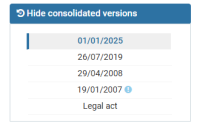
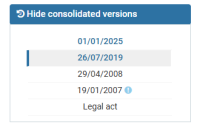 On these pages, we are trying to reference the EURlex pages explicitly consolidated in the last revision valid at the time of writing. This enables quick visual checking if the act was revised since we referenced it: any revisions that are newer than the referenced version mean that the act has been changed since our reference.
For checking whether a specific algal species or product is on the EU novel food authorisation list, the relevant informative tool is the Novel Food Catalogue maintained by the Commission's Directorate-General for Health and Food Safety (DG SANTE), which provides a searchable list of foods with an indication of their novel food status. But legally bound information regarding the novel food status is only in Union List of Novel Foods (Commission Implementing Regulation (EU) 2017/2470) EURlex - this consolidated link has almost surely been changed as the consolidation date is already 6 months old.
For feed materials, the EU Feed Materials Register provides the catalogue of recognised feed materials, including algae-derived materials, under Regulation (EU) No 68/2013.
Member State Law
This wiki focuses on EU law. However, for several important topics — particularly spatial planning and permitting, water use, waste classification, and organic certification controls — the directly relevant rules are national, not EU. EU Directives establish the framework and the objectives; member states implement them through national legislation that may vary considerably in detail, process and strictness.
Where national law is relevant, the chapters in this wiki note this and, where possible, indicate the key national competent authorities and point to national sources. Exhaustive coverage of all 27 member states' legislation is outside the scope of this wiki.
See also: Purpose, Scope and Sources | Bibliography | Other resources
Last reviewed: September 2026.